- El mejor turismo de galicia

The Galicia Tourism Cluster and the Pontevedra Provincial Council are driving the digital transformation of the sector with an intensive course on Artificial Intelligence applied to tourism
The Galicia Tourism Cluster and the Pontevedra Provincial Council are driving the digital transformation of the sector with an intensive course on Artificial Intelligence applied to tourism
- 25 professionals from Galician tourism companies are being trained in the strategic use of AI tools to improve competitiveness and operational efficiency.
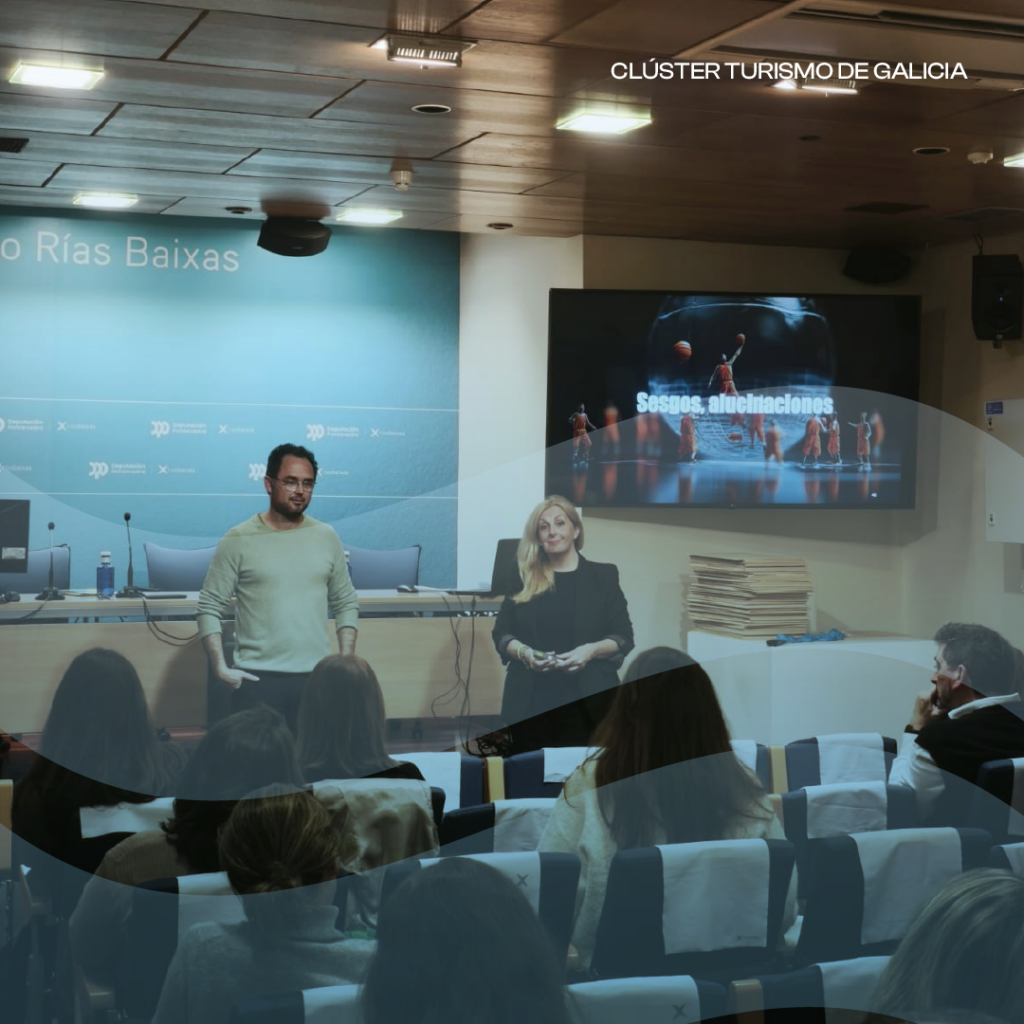
The Palacete de las Mendozas in Pontevedra hosted the training program “Smart Tourism: AI Tools for the Transformation of the Sector” from November 26-27 and December 17-18. This initiative, organized by the Pontevedra Provincial Council and the Galicia Tourism Cluster, with the support of the Xunta-Galician Tourism Agency, was aimed at professionals in the Galician tourism sector. The training, led by Enrique Lancis and Susana García, leading experts in tourism innovation and artificial intelligence, brought together 25 participants from hotels, travel agencies, complementary service providers, and other companies within the Galician tourism ecosystem.
The program, structured over 12 hours distributed across four three-hour in-person sessions, combined theoretical foundations with immediate practical applications, allowing participants to explore more than 10 artificial intelligence tools and design concrete strategies for integrating them into their organizations.
- A comprehensive journey: from fundamentals to practical application
The training began with an immersion in the fundamentals of AI and its impact on the tourism sector, addressing concepts such as Machine Learning, Deep Learning, and Natural Language Processing, as well as identifying opportunities for use in areas such as customer service, marketing, data analysis, and process automation. Participants also learned about emerging professional profiles and the fundamental ethical considerations in the use of these technologies.
On the second day, the focus shifted to mastering ChatGPT and other conversational tools, exploring the differences between models (GPT-3.5, GPT-4, GPT-4o), advanced prompting techniques, and, especially, the creation of customized GPTs tailored to the specific needs of each department or function within tourism companies.
The third session broadened the technological scope with the presentation of multiple generative AI tools and alternative language models. Participants worked with platforms such as Gemini, Grok, DeepSeek, and Mistral, and explored creative applications like SUNO for audio generation and Nano Banana for visual content. Furthermore, advanced concepts such as artificial intelligence agents and process automation tools using MAKE were introduced.
The fourth and final day was dedicated to the practical application of everything learned. Participants worked on designing customized roadmaps to integrate AI into their companies, differentiating between task automation and assisted improvement, and identifying internal processes where technology can add the most value. A highlight was the demonstration of use cases in tourism developed with AI agents using the GenSpark platform, which allowed participants to visualize how these technologies can solve specific problems in the sector in innovative and efficient ways. Critical aspects such as cybersecurity, customer data protection, the current legal framework, and the role of AI in sustainable tourism were also explored in depth.
Throughout the four sessions, participants showed particular interest in automating customer service processes, creating personalized content using generative AI, and developing custom GPTs that can function as specialized assistants in their business areas. Automation tools with MAKE and AI agents generated significant excitement due to their ability to optimize complex workflows without requiring advanced technical knowledge.
- Leading Trainers
Enrique Lancis, a graduate in Business Administration with a specialization in Finance and an International MBA from IE Business School, has over 18 years of experience leading tourism innovation and digital transformation projects. He was Director of Technology and Business Development at SEGITTUR, where he led the development of the Smart Tourism Destinations model for the Spanish Government. He is currently the founder of HumanIA Labs, a consultancy specializing in the application of artificial intelligence to tourism, and collaborates with ISO and CTN 178 on Smart Cities.
Susana García, a graduate in Economics and Business Administration from the Complutense University of Madrid, is the founder of 1012 INTELLIGENCE and author of the book “AI from Scratch: Artificial Intelligence Explained Simply.” With a background in companies such as Telefónica, Terra Networks and Hewlett Packard, Susana has established herself as one of the most prominent trainers in artificial intelligence applied to business, teaching in executive programs at EAE Business School, ISDI, Next Education and INCYDE Foundation, among others.


Related